

MALACHI MCINTOSH
THE WONDER OF BIRDS
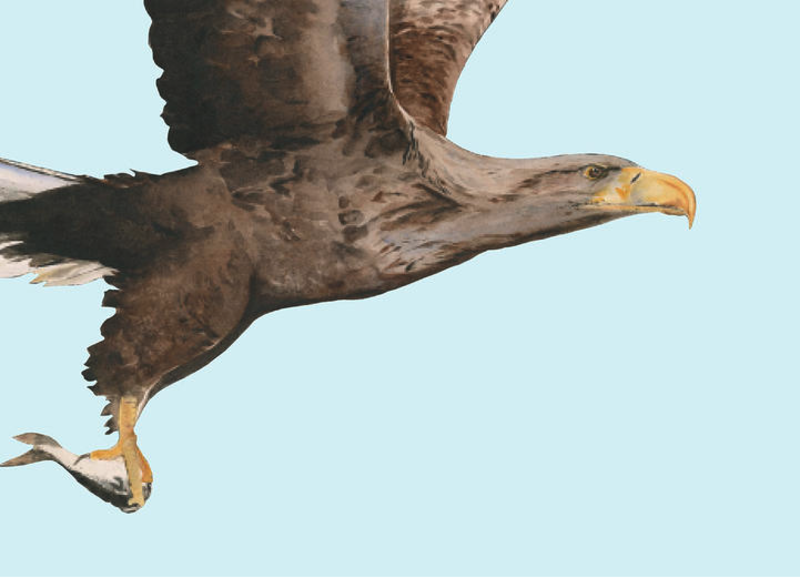
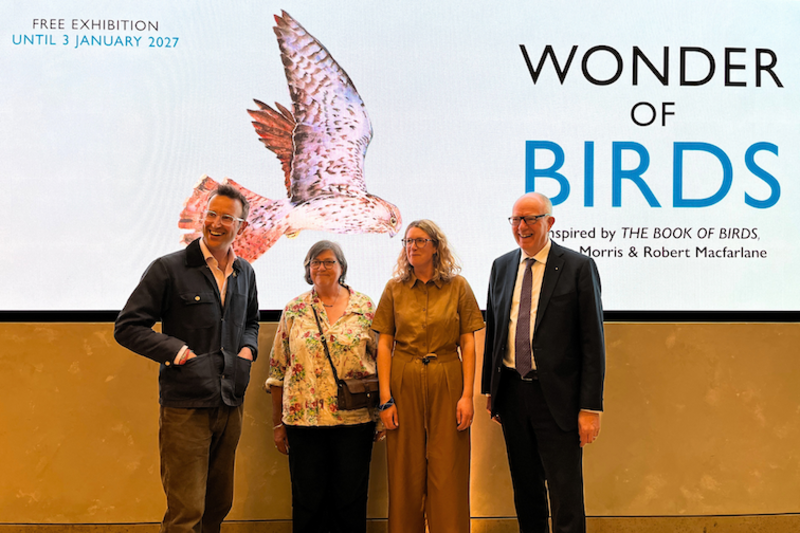
Free to the public and open from Thursday 7 May, the exhibition ‘The Wonder of Birds’ is now running at the Weston Library in Broad Street, part of the Bodleian Libraries.
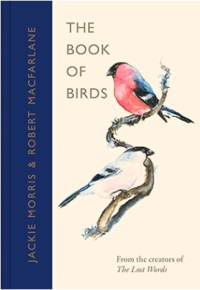
Curated by Antonia Harrison, the exhibition is also closely entwined with a marvellous new book published also on 7 May, called The Book of Birds (shown right) by award-winning nature writer Robert Macfarlane (Magdalen, 1997) and illustrator Jackie Morris.
Following the 'seven wonders' of birds – nest, egg, beak, song, feather, flight, migration – this exhibition pairs the words and art from The Book of Birds with Oxford ornithological research and Bodleian collections to explore the beauty and mystery of these extraordinary creatures.
Highlights include John Gould’s Birds of Great Britain, John James Audubon’s Birds of America, and never-before-displayed glass-plate negatives from naturalist Emma Louisa Turner.
The curator and authors all addressed a wide audience at the exhibition launch on Wednesday 6 May. Raised both on the observational field guides of Thomas Bewick (1753–1828) with their exquisite wood engravings of birds and simple, descriptive textual entries, MacFarlane and Morris said that they have sought to reimagine this tradition for our own time, calling The Book of Birds ‘a field guide’.
Beautifully embossed with gold fonts, hard backed and running to nearly 400 pages, it’s hard to say quite how this volume would tuck into your Barbour pockets while crouching in a thicket of spindle, but the spiritual intention is the same. If Bewick revolutionised the accessibility and wonder of birds to a broader public, so this book and exhibition seek the same impact in 2026.
A compendium of 49 species from avocet to yellowhammer, the book’s other stark message is one of loss. The unifying, harsh fact about the chosen species is that they are all on the risk list because declining in numbers.
The book begins, ‘A great thinning of skies is under way. There are three billion fewer birds in North America than half a century ago...’
Macfarlane emphasised the gravity of the situation at the launch, noting how in 1996 when the British ‘birds at risk’ list was drawn up it included 36 species. Now it numbers over 70, a complex result of agricultural intensification, habitat loss and climate fluctuation.
Of course, there have been successes, also noted. Red kites have successfully returned, so also gradually white-tailed eagles, and the kingfisher has been taken off the endangered list. One of the birds in the book is the marsh-dwelling bittern, which has apparently been sighted within the M25.
Yet the list is shocking. Not just the sparrowhawk but the sparrow too. Macfarlane says that turtle doves have suffered a 97% drop in numbers. Greenfinches and grey wagtails are birds that were recently common and now vanishing.
The authors don’t want to shock us, they want us to be inspired enough to act. Speaking on the BBC Radio 4’s Today Programme on 7 May, Morris said that the ethos of the exhibition and book throughout is not to ask ‘what’ (‘what bird?’) but ‘who?’ (‘who is this bird?’). Not as a sentimental gesture but as respect for the creature as having its own logic, its own purpose, its own being.
That respect of a bird’s identity comes across wonderfully from her generous, colour-saturated yet precise paintings of the birds, often against a dazzling chromatic background that conjures up dawn skies and flight. Apparently she would sometimes have to repaint a bird once she had read MacFarlane’s description, while he confesses to have taken two years to write just four entries, to establish a lyrical prose method that he was then able to accelerate. No wonder the book is the culmination of seven years’ labour.
The original paintings of some of the birds feature in the exhibition alongside remarkable Bodleian treasures such as Gerard Manley Hopkins’ (1844–89) original, hand-written manuscript for his famous poem about the kestrel, ‘The Windhover’.
The exhibition also draws widely on other collections, for instance displaying a great auk egg from the Natural History Museum, plus an incredible array of bird-calling devices that were invented over several decades to allow humans to imitate the calls of birds, typically for hunting purposes but more often today for the purpose of conservation – there is a swift ‘caller’ in the University Parks for example, to encourage the birds to establish nests.
Researchers in the University’s Department of Biology were also closely involved, such as Professors Ben Sheldon and Tim Guilford, both experts on migration and particular species such as the Manx shearwater, while as you enter the exhibition you encounter a soundscape of bird song assembled by the sound artist Jason Singh.
The exhibition urges people to consider what they can do as well, suggesting three things: download the free Cornell University Merlin Bird ID app, which is amazing at identifying different bird calls from many all singing at once; grow plants if you can that have seed heads and berries; and join a conservation charity like the British Trust for Ornithology or the RSPB.
move to carousel movement controls
 Pause slideshow
move to carousel content
Pause slideshow
move to carousel content
EBOLA: FIRST VACCINATION
EBOLA: FIRST VACCINATION
GRAPPLING WITH THE GHOSTS OF CARIBBEAN COLONIALISM
GRAPPLING WITH THE GHOSTS OF CARIBBEAN COLONIALISM
ADAM SMITH
ADAM SMITH
CONSERVATION AND WAR STUDIES JOIN HANDS
CONSERVATION AND WAR STUDIES JOIN HANDS
YOUR SUMMER GUIDE TO OXFORD
YOUR SUMMER GUIDE TO OXFORD

OFF THE SHELF: JUNE 2026
OFF THE SHELF: JUNE 2026

EBOLA: WE NEED MORE THAN A VACCINE
EBOLA: WE NEED MORE THAN A VACCINE
30 YEARS OF THE THAMES PATH
30 YEARS OF THE THAMES PATH
ANOTHER WORLD
ANOTHER WORLD
SATIRE COMES TO THE SHELDONIAN
SATIRE COMES TO THE SHELDONIAN
OFF THE SHELF: MAY 2026
OFF THE SHELF: MAY 2026
Pause slideshow

