
ANOTHER WORLD
100 YEARS SINCE THE GENERAL STRIKE

Most people have a passing or vestigial acquaintance with the General Strike, which began 100 years ago on 4 May 1926, ending on 12 May, when the organisers called it off.
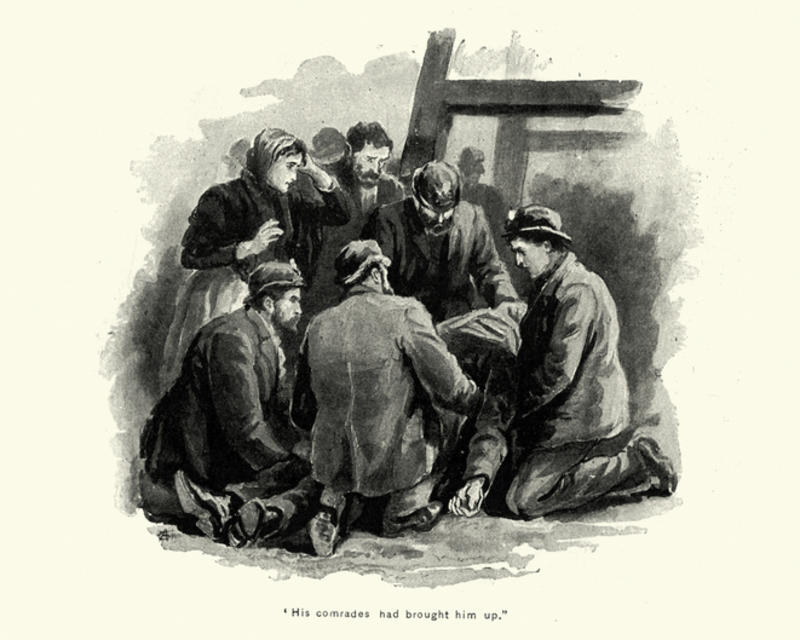
At the heart of it were approximately a million mine workers who, already habituated to a brutal livelihood, were threatened with wage reductions and an increase in hours by unsympathetic mine owners, who themselves were challenged by successive rollercoaster fluctuations in global coal markets following the end of the Great War in 1918.
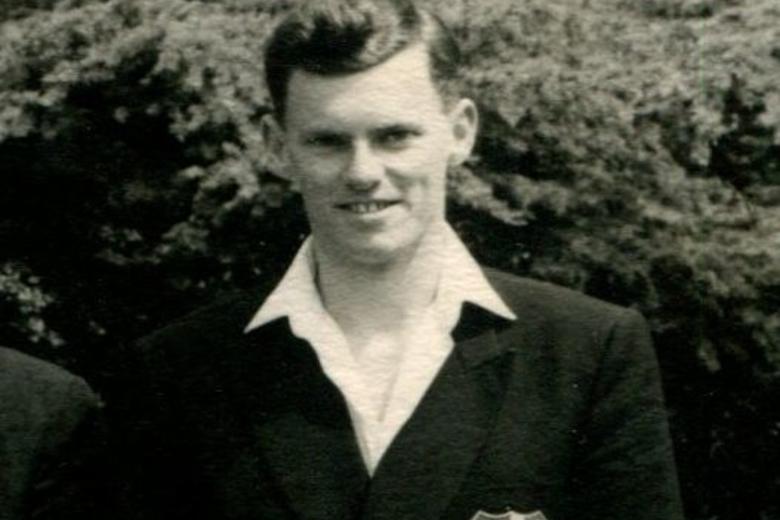
After a rich career as a historian specialising in this period of British history, American Jonathan Schneer (right), Emeritus Professor of the Georgia Institute of Technology, has written a tremendously engaging account of the entire thing, Nine Days in May: The General Strike of 1926, published by Oxford University Press on 26 March.
We spoke to him about the book and the events it depicts, ahead of the actual centenary.
His broadest pitch is unexpected. He says: ‘It [the General Strike] illuminates the human condition…there’s all of life in that nine-day period. It also tells you so much about Britain.’
What exactly is a ‘general strike’ as opposed to a plain old strike?
By 1900, Britain had over 1,000 different unions, covering all manners of trade and work, notes Schneer, and their legal status had been protected through successive legislation going back decades, in particular the 1906 Trades Dispute Act, which permitted peaceful picketing.
The idea of a general strike entailed all those unions striking together, whether for a political or industrial purpose, the theory being, obviously, that the whole was stronger than any single part of the whole. But, if effective – and the General Strike of 1926 was effective – then it would bring the entire country to a standstill, and that would threaten the government. In other words, a general strike threatens revolution.
This is where Professor Schneer’s book really gains momentum because the personalities involved on all sides are relatable, to the point where the narrative assumes the mantle of an epic tragedy.
After a rather shocking early stretch in the book reminding us what it actually meant to be a miner – my, haven’t we forgotten, if we ever knew – Schneer introduces by turn the major personalities, such as Sir Evan Williams and Sir Adam Nimmo, President and Vice-President respectively of the Mining Association of Great Britain (MAGB), representing the mine owners (described by Lord Birkenhead as ‘the stupidest men in England’).
Then onto the Miners’ Federation of Great Britain (MFGB), its General Secretary A J Cook, its President in 1926 Herbert Smith. Schneer brings everyone fully to life. Smith had gone down a mine aged 10, his father killed in a mining accident. His mother died soon after. He was put in a workhouse, rescued by adoptive parents, learned to box, went into the union world age 17.
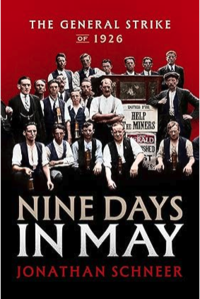
Extractive industries produce strong people on all sides, but the greater tragedy here was that ‘the mining industry was essentially bankrupt (everybody could see that) and needed to restructure’, the verdict of one of numerous government committees instructed to examine the industry and come up with solutions.
The committeemen and many politicians – against what readers might expect – tended to be sympathetic to the miners but could offer no prescription for reform, not understanding the industry. The miners themselves offered all sorts of things including that their number might have to fall by a quarter (250,000), seeing that the wage bill exceeded profits, but they would not countenance wage reduction because they could barely live on what they already earned, essentially having been undermined by strong inflation after 1918.
Schneer’s view of the mine owners is ultimately not very flattering. He says: ‘The Mine Owners’ Association really was so conservative. They just wanted to return to the days of grinding their employees.’
The sense of tragedy goes further still because union leaders had had many successes in recent years, going back to the Great War when the government had implemented a minimum wage over the heads of the owners, coal being essential to the war effort. Now, in the post-war period, rank and file miners were confident and militant; to them a strike backed by the entire labour movement seemed their ultimate weapon. The miners’ leaders saw the advantages in that too, but hoped that merely threatening a general strike would bring the owners to heel. But also they were hesitant: if they had to embark on a general strike it would inevitably draw in the government, with an unpredictable end result.
Meanwhile the Conservative government led by Stanley Baldwin sided with the mine owners partly because they objected to the miners’ blanket rejection of the owners’ terms, but more because they understood that an effective general strike would threaten their own authority.
Schneer gets us right into the ticking clock in the 48 hours before the strike was called, when the union committeemen were called to the House of Commons for last-minute, ultimately fruitless, negotiations.
‘Through the gloomy room’s windows “one could see the gleam of the Thames reflected from the masthead lights of a steamer lying at anchor…Round the table were the miners and our Committeemen.” J H Thomas, of the Railwaymen, sat next to Walter Citrine, acting general secretary of the TUC. The railwaymen’s leader did not believe in miracles. He whispered: “There is absolutely no hope…Baldwin [the Prime Minister] said to me tonight…We were not prepared last time, but we are prepared now.” They have got everything prepared, every bloody detail.’
This is the tiniest snapshot but it captures the fact that many union leaders were reluctant participants; also, that the enormous scale of calling out on strike three million workers had of it a bit of the ‘railway timetables’ quality of 1914, that once the command was given it couldn’t easily be rescinded.
Professor Schneer emphasises in conversation, as in the book, that for the most part none of the miners wanted to overthrow Parliamentary democracy, the Royal Family, or even private property (although mine nationalisation had long been an objective of some).
‘The abiding tone when the strike began referenced 1914. Strikers wore their medals to make the point that they were fighting an injustice, this time domestic, not that they were after a revolution. Strike breakers also considered their position patriotic.’
If there is a popular ‘memory’ of the strike it is typically rehearsed as middle and upper classes driving buses and trains to break the strike.
The chapter dealing with volunteers provides a corrective to the notion that it was all just a lark. The upper-class women who served soup in Hyde Park faced teeth-chattering cold while a string of tragedies resulted from inexperienced volunteers driving trains, trams and buses, leading to several crashes in which people died.
There is a rich section dealing with the response of Oxford and Cambridge Universities to the strike. Professor Schneer argues that Cambridge was notably enthusiastic in breaking the strike, whereas Oxford was split. Around the then Master of Univ, Michael Sadler, and the Univ economist G D H Cole, plus a wider galaxy of clerics, there emerged a wide disposition to not take sides, or even, thoughtfully, to support the strikers. That said, the Vice-Chancellor and many dons wrote an open letter condemning the strike, so Oxford ducked the chance to put its head above a parapet while not reprimanding its ‘hotter’ constituents.
The emergent right wing and British fascists cried Communism, says Schneer, but ‘largely misread the temper of the body politic’.
In fact, the government had taken fairly elaborate precautions and there was a reserve of coal.
Schneer says, in sum, ‘the miners were doomed. They could not have won, and I think at least some of their leaders knew it…’
We fall to discussing the subject as if at the end of a tutorial. Did the Marmite quality of the General Strike mean that it can be compared to Brexit? Did the rising role of electricity and oil in 1926 actually spell the long term decline of the entire sector, but no one saw it clearly (answer yes)? Were the mine owners guilty of underinvestment and falling productivity (answer yes)? Could a management consultant have solved everything owing to it being really a business problem rather than a political one (probably not, it had become political)?
We touch on the coal strike of the 1980s. Schneer does not refer to it in the book, preferring the history to do the talking (although he quips, ‘never have a strike at the convenience of your opponents,’ a reference to spring striking when coal demand is least).
At different times a Visiting Fellow at both St Catherine’s College and Merton, for the purpose of researching this book, Professor Schneer says his next work is a co-authored study of US and UK critics of neo-liberalism that will be published by Yale University Press. Meanwhile, of his back catalogue one volume has never fallen out of print, The Balfour Declaration: The Origins of the Arab-Israeli Conflict (2010).
Professor Schneer will also give this year’s Ewen Green Memorial Lecture at Magdalen College on 30 April at 5pm (details below – all alumni are welcome to attend).
move to carousel movement controls
 Pause slideshow
move to carousel content
Pause slideshow
move to carousel content
SATIRE COMES TO THE SHELDONIAN
SATIRE COMES TO THE SHELDONIAN

OFF THE SHELF: MAY 2026
OFF THE SHELF: MAY 2026
THE WONDER OF BIRDS
THE WONDER OF BIRDS

FRAN MONKS
FRAN MONKS

OXFORD ALUMNA NOMINATED FOR TURNER PRIZE
OXFORD ALUMNA NOMINATED FOR TURNER PRIZE

OFF THE SHELF: APRIL 2026
OFF THE SHELF: APRIL 2026

VALUING SILENCE
VALUING SILENCE

‘BIG BANG’ OF ANIMAL LIFE EARLIER THAN THOUGHT
‘BIG BANG’ OF ANIMAL LIFE EARLIER THAN THOUGHT
OXFORD’S WOMEN TRIUMPH IN THE BOAT RACE
OXFORD’S WOMEN TRIUMPH IN THE BOAT RACE
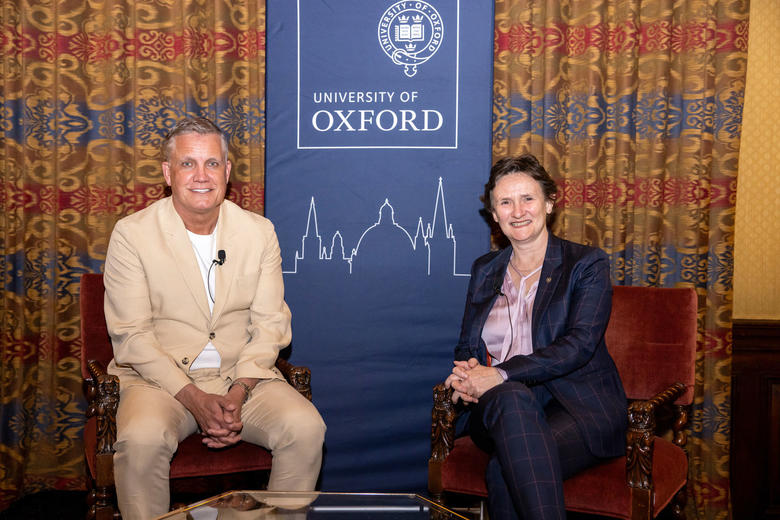
AN EVENING WITH THE VICE-CHANCELLOR IN LOS ANGELES
AN EVENING WITH THE VICE-CHANCELLOR IN LOS ANGELES

MAKING SPACE SUSTAINABLE
MAKING SPACE SUSTAINABLE
Pause slideshow

