

EBOLA: FIRST VACCINATION
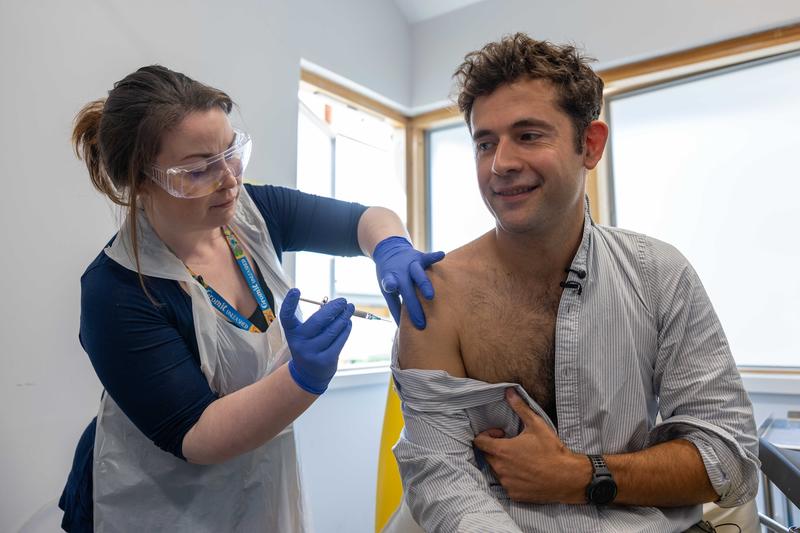
The first volunteer is vaccinated in the world's first Bundibugyo ebolavirus vaccine trial
Published: 24 July 2026
Share this article
The University of Oxford’s Oxford Vaccine Group has successfully vaccinated the first volunteer in the world’s first clinical trial of a vaccine designed to protect against Bundibugyo ebolavirus (BDBV).
The milestone comes just weeks after the launch of the BD-Ebov study and marks the first time the ChAdOx1 BDBV vaccine has been administered to humans.
The ChAdOx1 BDBV vaccine was developed by scientists at the University of Oxford’s Oxford Vaccine Group and Pandemic Sciences Institute using the same vaccine technology as the Oxford/AstraZeneca COVID-19 vaccine, which is estimated to have saved around six million lives during its first year of use.
The speed of the programme has been enabled through a truly collaborative and global approach and is built on decades of vaccine manufacturing capabilities at the University's Clinical BioManufacturing Facility (CBF) and the Serum Institute of India (SII). SII manufactured ChAdOx1 BDBV vaccine in a record time and stockpiled 620,000 doses.
The study team will continue recruiting and vaccinating volunteers over the coming weeks while monitoring participants to assess both safety and immune responses generated by the vaccine.
The trial is supported by funding from the Coalition for Epidemic Preparedness Innovations (CEPI) as part of a US$8.6 million programme to the University of Oxford and SII to advance Bundibugyo vaccine development activities.
Dr David Pulido-Gomez, Global Chemistry, Manufacturing and Controls (CMC) lead, Pandemic Sciences Institute, Nuffield Department of Medicine, said: ‘Reaching this milestone in such a short timeframe reflects an extraordinary collaborative effort. Working alongside colleagues at the CBF and SII, we've taken this vaccine candidate from concept to clinic in just eight weeks.’
Dr Peter Skydmore, Lead Study Doctor for the BD-Ebov trial at the Oxford Vaccine Group, said: ‘Vaccinating the first participants in a first-in-human study is always a significant moment. While these are very early days, they represent an important first step in evaluating this vaccine in humans. Over the coming months, we will continue vaccinating and monitoring participants, and assessing the safety and immune responses generated by the vaccine.’
Katrina Pollock, Chief Investigator for the trial said: ‘This is an important milestone for the trial, and marks the next phase in our multinational collaborative journey to develop a Bundibugyo ebolavirus vaccine. With the help of our many vaccine research partners and importantly, the clinical trial volunteers, our team will continue to work tirelessly in our response to this severe outbreak.’
Professor Teresa Lambe OBE, Pandemic Sciences Institute and Oxford Vaccine group, said: ‘This latest step reflects the dedication of the general public and our volunteers in not only supporting but enabling a key response in the face of an ongoing and devastating outbreak. Their contribution is helping advance vaccine candidates into communities that need them most.
‘We are also grateful for the sustained support of our funders, including CEPI, NIHR, UKRI and to the MHRA for its rigorous and responsive oversight, which has enabled the rapid progression of this first-in-human study.’
‘With Bundibugyo cases increasing at a concerning rate in the DRC, this epidemic shows no signs of stopping. The need for a vaccine against this specific Ebolavirus becomes more urgent every day,’ said Dr Richard Hatchett, CEO of CEPI, the funder of this trial. ‘The rapid work of the Oxford team to begin early-stage testing of their vaccine is a much-needed step towards developing the tools that could help bring this outbreak to an end.’
Mr Adar Poonawalla, Chief Executive Officer, Serum Institute of India Pvt Ltd, said: ‘The commencement of Phase I clinical trials for the ChAdOx1 BDBV vaccine is an encouraging milestone in the response to the current outbreak. We thank our partners for their dedication and shared commitment in advancing this programme at exceptional speed.
‘Manufacturing this vaccine candidate in record time and ensuring doses were available to support its clinical development demonstrates how preparedness, scientific innovation and scalable vaccine production can accelerate the development of solutions for emerging infectious diseases. We remain committed to supporting global efforts to improve equitable access to vaccines where they are needed most.’
Subject to regulatory approval, preparations are also underway for further clinical studies of the vaccine with partners in Uganda.
If early-stage trials are successful, CEPI anticipates working with the University of Oxford and SII to support late-stage trials to generate data for emergency use authorisation or licensure.
CEPI, SII and the University of Oxford are committed to enabling rapid, affordable supply of Bundibugyo virus vaccines to affected countries and to the populations that need them.
SII has manufactured and stockpiled approximately 620,000 doses of the ChAdOx1 BDBV vaccine within two weeks for potential future use and has supplied 4,000 investigational doses for this trial.
Visit Oxford Vaccine Group's Vaccine Knowledge website for more information about Ebola viruses or Ebola vaccines.
The Oxford Vaccine Group (OVG) is part of the Department of Paediatrics at the University of Oxford. It led the rapid clinical development of vaccinations against COVID-19 in the pandemic and has made significant contributions to knowledge, supporting national and global policy on immunisation over three decades. The OVG was founded in 1994 by Professor E Richard Moxon. It is one of the world’s leading academic vaccine research teams, and has been led by Professor Sir Andrew Pollard since 2001. The OVG undertakes vaccine research spanning basic science and preclinical studies through to epidemiological studies, human challenge models and phase I–III clinical trials. Current research includes the study of vaccines for outbreak pathogens and pandemics, enteric pathogens, bacterial and viral respiratory infections, and use of human challenge models to accelerate vaccine development.