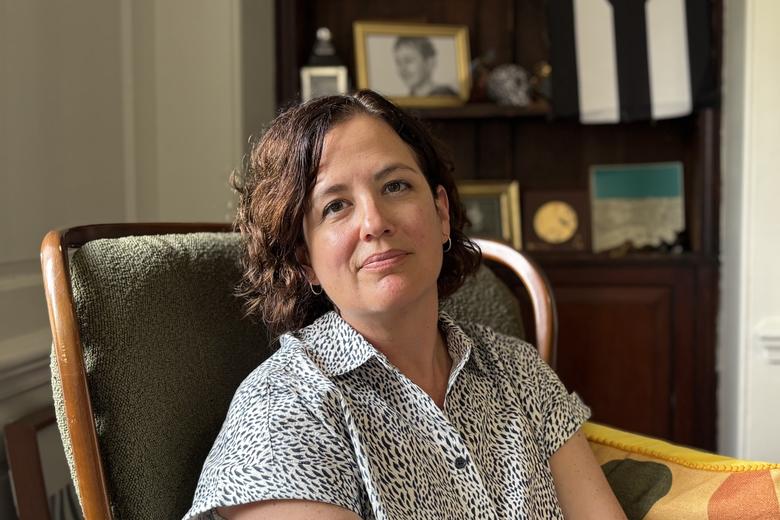
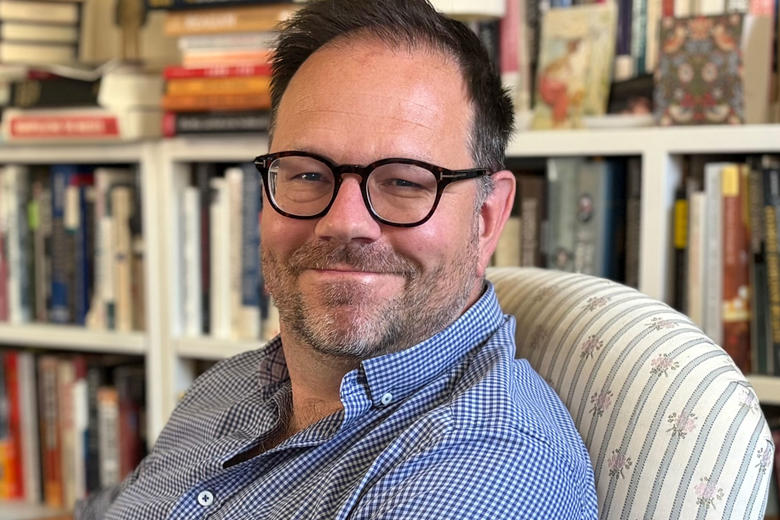
‘Real innovation,’ says Malachi McIntosh, recalling a conversation with a radical academic, ‘happens on the periphery.’ As a framing device it describes his own biography and career to a surprising degree, plus his regard for what makes St Hilda’s College special.
An Associate Professor in World Literatures in English since 2022, and Barbara Pym Tutorial Fellow at St Hilda’s College, his range and life experience is remarkable.
Born in Birmingham in 1980, he moved to the US with his mother when he was three, with a childhood partly in the Bronx, New York City, and later in Tampa, Florida where he eventually completed his first degree at the University of South Florida.
He then completed an MA in Comparative Literature at King’s College London, and a PhD at Warwick University with a subsequent research fellowship there in 2011–12. He was then appointed a permanent lecturer at Cambridge but left after four years to work at the Runnymede Trust think tank and then as the editor of the magazine Wasafiri.
Already a varied path, his biography is particularly crunchy, in a good way, around the period of his PhD.
He began his thesis while working in a challenging school as a part of the Teach First programme. Founded in London in 2002 by Brett Wigdortz and Nat Wei – now Baron Wei – Teach First says that since its first year it has helped 1 in 3 disadvantaged pupils in England, in 5,500 schools. It offers a two-year funded package to successful applicants, and after brief training throws them into a real school situation, which Professor McIntosh remembers as ‘unbelievably tough’ yet in other regards the best thing he ever did.
‘At the time, within the two years you also took courses on business. The pitch was “teach for two years then go do something else if you prefer”, so they were committed to providing and stressing transferable skills. We had courses on corporate strategy, marketing, financial management. A group of tired, 20-year-old school teachers packed into Imperial’s Tanaka Business School on a Saturday! I hadn’t learned about any of this before. For an English graduate to get lectured on market segmentation and SMART targets, as concepts, this was amazingly useful.’
It fed directly into his non-academic work and co-leadership of 'Our Migration Story', his project at the Runnymede Trust that tried to smash open the story of migration to the UK so that teachers could teach it.
‘Teachers had been saying for years that they wanted to teach migration but had limited knowledge of where to start. They wanted a broader context and quality resources that filled in their own educational gaps.’ What initially began as a website that would signpost existing scholarship snowballed into a much more hands-on effort.
‘It was a manic six-month period. Working with Dr Sundeep Lidher we commissioned stories but also explored curriculum relevance and practicalities. You come across rhetoric in Britain that suggests migration is something that started last Thursday, and so it was essential to go as far back as we could in time. It was Windrush, very live when we were working, but also other stories, such as children of the East India Company, Huguenots in East London, Jewish presence in the 12th century, St George’s roots in Cappadocia (now Turkey), anti-German riots around WWI, Queen Victoria’s Punjabi goddaughter Sophia Duleep Singh.’
Dr Lidher is currently Lecturer in Black and Asian British History (post-1800) at King’s College London.
Describing the experience as ‘wonderfully cathartic’ the project went on to achieve several million users and to significantly change the teaching of this subject in British schools.
‘It showed me what’s possible with academic research and the potential for public engagement. A recent ten-year anniversary brought together the team and teachers who use the site in their schools. It reminded me that collectively we bridged a real gap in public and inter-generational knowledge. It’s the thing in my career I’m most proud to have done.’
‘Our Migration Story’ won numerous prizes, perhaps the most prestigious being the Royal Historical Society Public History Prize (2018), awarded for Best Online Resource.
Professor McIntosh also remembers getting pushback on Twitter including from a senior, public-facing historian who said that the project overestimated the role of migration in forming Britain, to which McIntosh says: ‘You can’t understand Britain without migration. Most major historical events we mark are tied to it. The industrial revolution; the defence of the island in the World Wars; women’s suffrage; emancipation, obviously; the extension of the franchise; anything linked to the current royal family. Empire – whether you think it’s a source of pride or shame – was one massive, unfolding series of in- and out-migrations.
‘Looking back, I think pushback was useful, or at least enlightening. It confirmed to me how much we don’t teach, in both schools and universities. It happened around the Windrush saga, when it became clear that members of the government didn’t realise colonial residents were British citizens – that for many people from the West Indies, in particular, the only citizenship they had access to was British as the descendants of the enslaved, who didn’t have the right to be citizens of anywhere. It really opened my eyes.’
Speaking to Professor McIntosh in late May places us right on the cusp of both Windrush Day, which in 2026 marks the day 78 years ago when the ship carrying Jamaican immigrants docked at the Port of Tilbury, Essex, on 22 June 1948, and the tenth anniversary of the Brexit referendum the very next day, 23 June, which is bound to dredge up hot debate in all directions.
All of this is relevant to the conversation, because Professor McIntosh’s initial subject of academic inquiry concerned six writers who came of age during the early-to-mid-20th century, drawn variously from Barbados, Trinidad and Tobago and Martinique.
The basis of his PhD and first book Emigration and Caribbean Literature (2015) was the argument that these otherwise disparate writers and thinkers were trying to get ‘out’ of their own societies as much as they were trying to get ‘in’ to British and French host nations and elite institutions.
The very notion to some extent turned on its head broad assumptions about the nature of Caribbean writers’ works at the time, which were seen to offer some essential insight into the lives of a peasant underclass. Looking back at the work now, a decade later, prompts Professor McIntosh to say: ‘It’s a very complicated subject – class in the context. These writers were critical of their own societies and were often middle class. They dreamt of being accepted into cultural circles which they had only heard about, knowing that literature and letters were respected in Britain differently. When they got here the adjustment was huge. There was inevitably much disappointment, including from face-to-face contact with discrimination. They thought that knowing the culture was enough, that good grades were enough, but they weren’t. They slide into a kind of under-middle class on arrival.’
Of the six writers Professor Malachi studied (George Lamming (1927–2022); V S Naipaul (1932–2018); Samuel Selvon (1923–94); Mayotte Capécia (Lucette Combette, 1916–55); Aimé Césaire (1913–2008); and Édouard Glissant (1928–2011)), one was also a student at Oxford and initially hated the place: V S Naipaul (Univ, 1950).
Naipaul's experience is also illustrative of how phenomenally complex identity can be. Born in Trinidad, part of the British Crown colony Trinidad and Tobago, both Naipaul’s paternal and maternal grandfathers had emigrated from India to Trinidad in the last two decades of the 19th century, their prospects blighted by the Indian Great Famine of 1878–80.
This is partly what Professor McIntosh is referring to when he considers the British Empire to have been ‘one massive act of emigration’.
What such moves within the British Empire did was to intricately layer one identity upon another, subsequently to be re-expressed in beautiful, sometimes wrenching fiction that was both autobiographical and universal – such as Naipaul’s first big hit A House for Mr Biswas (1961).
While the experience of being penniless and cold in the still-austerity Britain of those immediate post-war years was tough, Professor McIntosh says that the BBC offered opportunities, through shows such as Caribbean Voices, that accommodated and explored the emergent voices of this literary scene.
‘There was hope post-war; it wasn’t all bleak. The economy was strengthening. Some of these writers published to acclaim. Britain was a place of possibility. By the time we get to the '70s when that had stalled and Powell prophesied his 'Rivers of Blood', the mainstream marketplace for Caribbean fiction became much tougher. In effect it dried up.’
A group of writers actually got together to explore a harder identity in response to this, partly in rebellion and partly in pursuit of poetic and political reflection. Known as the Caribbean Artists Movement, the group forms the basis of a current book Professor McIntosh is working on that will be published by Faber & Faber.
It’s not the only thing McIntosh is working on. A fiction writer alongside his academic work, having published the award-winning short-story collection Parables, Fables, Nightmares in 2024, he says that just the previous week he had resolved the direction of a new novel – and then adds that his next academic inquiry will concern Guyanese writer Edgar Mittelholzer (1909–65) who wrote 27 novels ‘but is barely referenced today, partly because he developed some views that were… frankly pretty unhinged’.
Another example of infinitely complex identity, Mittelholzer’s forebears were Swiss-German, French, British, and African Caribbean. Professor McIntosh notes also that Mittelholzer set himself alight in a field near Farnham, Surrey, dying the next day at Farnham Hospital. The suicide echoes the deaths of some 15 of his fictional protagonists and prematurely ended a life that had included harrowing service for Britain during World War Two along with creative work performed on Broadway.
Mittelholzer was a devotee of Richard Wagner and flirted with fascism later in life. He’s not a comfortable cup of tea.
We touch on the fact that Professor McIntosh’s post is called ‘World Literatures in English’ rather than the potentially loaded word ‘post-colonial’; I also ask whether French poet and philosopher Édouard Glissant’s idea of opacity (and one’s ‘right to it’) is of use here, digging around for a meaning to Mittelholzer’s self-immolation, but I’ve evidently plonked an unsubtle Anglo-Saxon foot into a very refined pool of French post-modernism and high theory.
Nonetheless, in the Poetics of Relation, the Martinican Glissant sought to frame the rapid emergence of a multicultural world amid hot wars of decolonisation such as the French war in Algeria, and one idea that emerged from it was the limits to human empathy and the idea that certain identities might be experienced as unknowable to others, or as untranslatable in language, that humans might have ‘to simply exist as different’.
We are now in a world of populist tumult laced with the threat of mass deportation, both in Britain and elsewhere. Is this a threatening moment for Professor McIntosh? ‘I don’t feel policed but I do feel a sort of surveillance,’ he says, adding, however, that St Hilda’s has been warm and welcoming, and that unlike King’s College Cambridge (where he was based and where ‘non-fellows can’t walk on the grass’) at St Hilda’s there is no conventional quadrangle and all-access grassy slopes next to the river; a former women’s college full of progressivism.
On Brexit, he says: ‘There was speechlessness in London, where I was working, at the outcome. But at a Brewdog pub in Birmingham just after, I overheard some men talking about how happy they were about it. It never felt impossible to me the way it felt to some others, but this world isn’t the only world I live in. From certain vantage points it’s been easy to overlook how intensely the status quo is failing people.’
He continues: ‘I teach Benedict Anderson’s now pretty canonical Imagined Communities. In it, he argues that national groups need a story they can tell about themselves in order to be coherent. Objectively most members of a state are strangers; we need narratives to create unity despite this. Britain is still struggling to tell itself a good story about its present because it always seems to see its best in the rearview mirror. That works well for folks like Farage because ethno-nationalism is always about the past – “Everything would be great if we just rolled back to whenever” – I’d love to see a counternarrative that looks forwards, that sees real value in what we are and what we could be. But that’s tricky in a time of acute uncertainty. Much easier to flick through the photo album.’
We agree that in some ways Britain hasn’t moved on very much from former US Secretary of State Dean Acheson’s quip at West Point in 1962, that ‘Great Britain has lost an empire and has not yet found a role’, a view that sounds as relevant in 2026 as it may have been then.
As he’s developed his fiction writing over the past two decades, McIntosh says he’s grown more comfortable with ‘openness, inconclusivity and strangeness’. ‘Everything in my short story collection is kind of jagged, fragmented. That’s what I like most about it.’ That desire for complexity seems to carry into other parts of his life and work.
We speak for about an hour. We laugh at the British interest in what ‘generation immigrant’ you are, a question rarely asked of migrants with roots in Europe, discuss the many hierarchies in contemporary society, and he reflects critically on what he calls the international ‘quest for fixity’. Citing St Hilda’s own Professor Margaret Kean’s recent lecture on Philip Pullman’s fiction, he quotes her quote of Pullman that ‘no system is complete until it has a hole in it’.
‘It’s counterintuitive but I like it. For me it translates simply into “no system is ever complete”. The smooth and uniform is a myth - a fantasy. So don’t waste time chasing it.’
Whether as critic or as direct participant creating literature reflecting diasporic experience, Oxford has numerous reasons to celebrate and thank Professor McIntosh, an outstanding leader in his field.


 Pause slideshow
move to carousel content
Pause slideshow
move to carousel content