



MASTERPIECE DISCOVERED AT CAMPION HALL
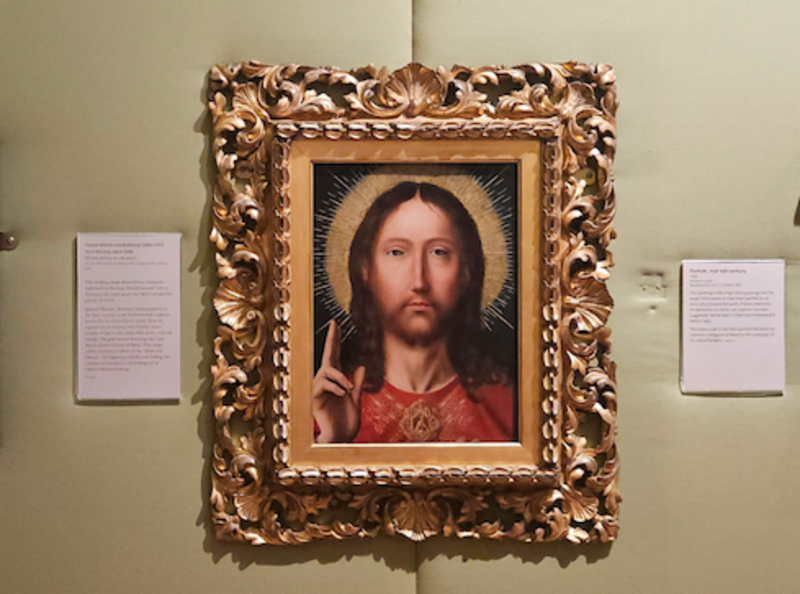
Hidden masterpiece ‘Christ Blessing’ from Campion Hall is now on display at the Ashmolean
Published: 22 December 2025
Share this article
A remarkable painting that had long hung quietly on the walls of Campion Hall in Oxford has been confirmed as an original work by Flemish master Quentin Massijs (1466–1530) and Workshop, dating from around 1500.
The small but striking image, Christ Blessing/Salvator Mundi, is now on display at the Ashmolean Museum in Oxford in the Flemish and German Gallery, the timing coincidentally also the lead up to Christmas 2025.
The rediscovery followed a chance visit by an expert connected to the National Gallery, which led to an in-depth scientific investigation by leading Flemish art authority Dr Maximiliaan Martens. The experts' curiosity was flagged initially by the way the hair of Christ had been depicted, suggesting that the painting was by the hand of Massijs rather than his wider workshop.
An Van Camp, Acting Keeper of Western Art & Curator of Northern European Art, compares Massijs to a ‘pop star of the late 15th, early 16th century Renaissance’, noting that there are numerous images of this depiction of Christ, that it was a ‘winning image’ and duplicated many times, but that this particular painting was evidently special. It would have been painted in Antwerp, where Massijs had his workshop.
Using infra-red imaging and other advanced techniques, Dr Martens confirmed that the painting’s under-drawing and composition match Massijs’ own working methods, revealing it as the original from which later copies were made.
An event was held at Campion Hall in November to reveal the identity of this long-hidden masterpiece.
The painting was originally purchased by the then Master of Campion Hall Fr. Martin D’Arcy on July 9, 1937 from Christies, for £4.40.
Master of Campion Hall, Dr Nick Austin SJ, says that the painting had long been regarded as ‘incredibly beautiful’, even before its restoration led to the discovery of its authorship. ‘It asks for a response from the viewer. It’s not just a work of art.’
It can be understood within the early reaches of what would become the Reformation, where iconography even within the Catholic confession was moving from Christ depicted as a distant monarch to Christ depicted as a personal saviour with whom a dialogue was possible.
Dr Austin says, ‘To stand and pause before this painting is not only to admire its beauty or the virtuosic skill of the Master’s hand, but to risk being transformed. Our hope is that, in its new home, many more people will spend time contemplating this image of the Blessing Christ and dare to meet the gaze of the One it so powerfully reveals.’
Campion Hall is one of four Permanent Private Halls in Oxford, opened in 1896 by The Society of Jesus on a site in St Giles. Later, the Hall moved to its current premises on Brewer Street, opposite Christ Church, where the architect Edwin Lutyens transformed a pre-existing building, the new Hall opening in 1935-6.
This was all possible because of the University Tests Act of 1871 which for the first time permitted non-Anglican members of the University.
Founded by the Jesuits in 1896, Campion Hall is home and a centre for research and learning at the University of Oxford. Shaped by Jesuit educational traditions, it offers graduate students a holistic learning environment that nurtures the heart, soul, and mind, inspiring them to contribute to the greater good of society.
The Ashmolean is the University of Oxford’s museum of art and archaeology, founded in 1683. Its world famous collections range from Egyptian mummies to contemporary art, telling human stories across cultures and across time.