


KEVIN GRECKSCH

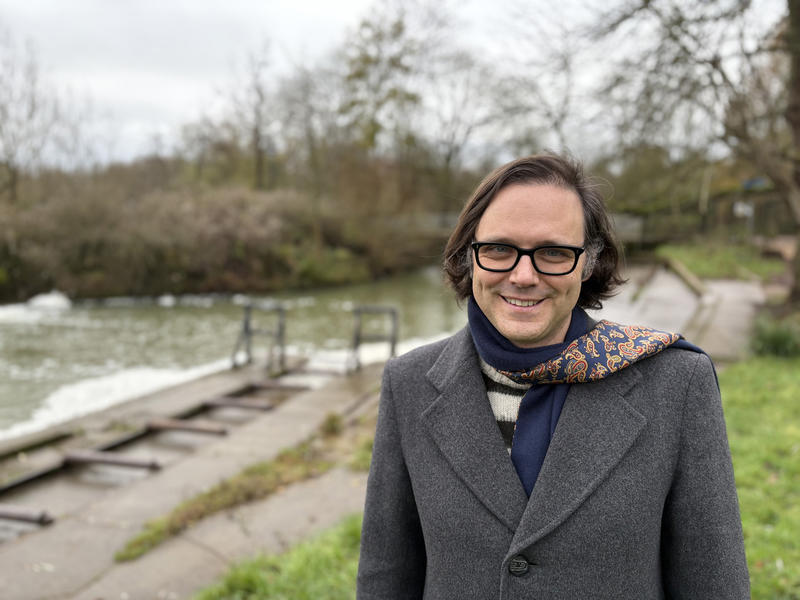
Dr Kevin Grecksch stands by the River Cherwell on 27 November 2025

KEVIN GRECKSCH

Oxford’s water expert Kevin Grecksch discusses policy challenges and suggests solutions

Published: 12 December 2025

Author: Richard Lofthouse


Share this article

Dr Grecksch’s profile declares him a fan of active learning, so no surprise when he suggested that we talk by the river, a five-minute stroll from Linacre College at the Cherwell.

We are immediately in front of the punt rollers that lower you from the upper stretch that meanders by Lady Margaret Hall and Wolfson. It’s muddy but not as cold as the day before, in late November, but not warm enough to sit so we conduct a standing interview.

He says the active learning came out of two things: ‘being bored at windowless conferences discussing the outdoors’ and a brilliant ‘learning with objects’ module offered by the Ashmolean Museum that led him to take students to decipher a water pipe in a room that restages the Cretan Temple of Knossos.

‘By the time students have worked out that it isn’t a strange woodwind instrument next to the throne, they have begun to realise how strategic and powerful water was and why such a pipe might be a symbol of power.’

That sort of lateral thinking partly explains why Dr Grecksch is responsible for the UK’s only interdisciplinary master's programme in Water Science, Policy and Management. Another factor is his background – before he came to Oxford’s School of Geography and the Environment (SoGE), he was a postdoctoral fellow at the University's Centre for Socio-Legal Studies. This followed doctoral studies at Oldenburg University in Germany and a stint as visiting researcher at Nelson Mandela University, Port Elizabeth, South Africa.

A social scientist, really he covers all the angles of watery complexity: politics, economics, engineering, water governance. These big objects split down under headings such as climate adaptation, ecological economics, property rights – it’s a long list. But he says that he encourages all his students to think broadly.

‘There might be an engineering solution but it is typically the start of a broader conversation, not the end.’

We can hear the adjacent weir, which is tumbling away pretty vigorously after recent rain, but don’t be fooled, he says.

‘Reservoirs should be at 80–85% of capacity by late November but the average in the UK is just 60%. Without sustained rainfall in the next two months we’ll be looking at a very severe drought in 2026 in Britain.’

I can’t resist plunging into the topics that fill the daily airwaves in the UK in 2025: what about the future of the utility company Thames Water, functionally bankrupt owing to unsustainable debts; and in the broader sense whether the UK is an outlier if we look at water management globally?

‘Britain is, yes, it’s highly unusual. We have to rephrase that to England and Wales. It’s different in Scotland and different in Northern Ireland. England has a fetish for private property, but water here does not share those rights, unlike in the US where water rights accompany land rights. We don't have this here. If you want to extract groundwater here, you need a licence from the Environment Agency.

‘But the really big point of difference is that England and Wales are the only two nations in the world where water supply and wastewater treatment are 100% privatised. The only other nation that comes close to it is Chile... I have some of the pre-privatisation documents in my office, from the late 1980s ahead of privatisation in 1989. This was a radical solution then, the government saw it as the model for the world. The ideas were pitched abroad, but they never caught on; meanwhile the experience here was good in the short term and bad in the longer term.’

Kevin says that the central error made with water privatisation was treating water as another utility like electricity or gas.

‘What they did was to bring in people from the energy sector, and they had absolutely no clue about water. And there are fundamental differences. People always say, ‘oh, it's a utility.’ No: it’s water. Water is a natural monopoly. This is why you're stuck with Thames Water.’

He corrects himself. Apparently, businesses above a certain size – this would include Oxford University – could actually have a different supplier, but of course that supplier would still be buying water from Thames Water. ‘It just creates another mess, an intermediary...

‘It’s still a natural monopoly. It's a cash machine. It’s an ATM, because we all need water. It's the single stuff we need to survive. True, yes, we could be more careful with it, but I’m always cautious when people say we need to ‘save’ more water. You cannot exist without consuming it. There comes a point where you can't save actually more water. You just simply need it. And obviously, this is the underlying business model. The initial idea was to throw off the lethargic state and open up innovation, but they [the water companies] are not innovative now. There's a regulatory framework, which gives the water companies action points, what they have to do. Measures they can implement. And that's what they stick to. They could do a lot more, and there's a lot more in the academic literature. There is a lot more going on towards active water management in Australia, US, Canada, but we’re not doing any of that here; the regulators have failed. The Environment Agency actually has a lot of power but it doesn’t exercise it.’

He has just submitted lots of evidence to a parliamentary consultation on drought preparedness. He jokes that the ‘drought’ people want new supplies and talk reservoirs and rain capture, while the ‘flood’ people are preoccupied with getting rid of water out to sea as soon as possible. ‘If you could divert a fraction of the flood water it could be used to achieve what is called ‘aquifer recharge’, where ground water is increased ahead of the next dry season. There are solutions, but we're not actually exercising them.’

Would it be a good idea to adapt the building code so that every house had rainwater capture from the roof to a butt, as any gardener already knows and does? Yes, he agrees without qualification. It would be easy but we don’t do it.

There are positives. He says that the water companies, Environment Agency, Department for Environment, Food and Rural Affairs (DEFRA), National Farmers' Union, and some of the big food and beverage industry players, are coming together in resource boards, grouped regionally. They’re finally talking to each other. 

‘This is a recent development and this sort of constant conversation is much needed.’

We move on to artificial intelligence and the water-cooling requirements of a big data centre of the sort that is going to spring up everywhere, or so we are told. Kevin says that they need a lot of water, that it must be very clean, and that it’s going to start at 16–17°C and exit at 23–24°C, which is hot enough to kill aquatic species. A lot of the water evaporates during the process, as much as half. So the raw need for water is huge.

Kevin says there is a crippling shortage of data on this subject because the big tech companies are ‘very shy about this for obvious reasons’.

‘The tech juggernaut is not interested in any of these issues right now. It’s pressing on relentlessly.’  

Next on the agenda is the big reservoir planned for South Oxfordshire near Abingdon. ‘My gut feeling is that it will happen but for the wrong reasons.’

The money men like physical assets on the balance sheet of Thames Water and a new reservoir is a good one, Kevin explains. But the water in it is destined to serve London, not Abingdon, so the local resistance is fierce. And even if it goes ahead it will not be open until 2040 at the earliest, with real engineering issues to be overcome and large volumes of transport of rock from the north and so forth, because the reservoir is not going to be the outcome of flooding a valley but digging a hole from scratch out of a flat landscape.

‘Look at the geography of Oxfordshire. It would be a huge undertaking.’

We turn to research taking place among Kevin’s students. A DPhil student, Jess Ryan-Smith, is exploring the potential to convert certain categories of residential lawn to native planting in Chicago; another, Florian Steig, is studying ‘power and knowledge in the global governance of sinking cities’.

You might be thinking of Venice, but Kevin emphasises Jakarta, the biggest city in the world, and also mentions Miami. ‘If you drain the land to make it habitable, it sinks. With climate change we also have rising sea levels.’ That offers the tiniest glimpse into a wide range of fascinating research projects that are unfolding under Kevin’s watch, but our time standing by the Cherwell is up and we stroll back to the science area.

One senses that away from all the intense excitement around certain forms of technology right now, it is access to clean water that will ultimately govern what is possible in the century ahead.

Dr Kevin Grecksch is Associate Professor of Water and Environmental Governance, Programme Director, MSc in Water Science, Policy and Management.

The School of Geography and the Environment