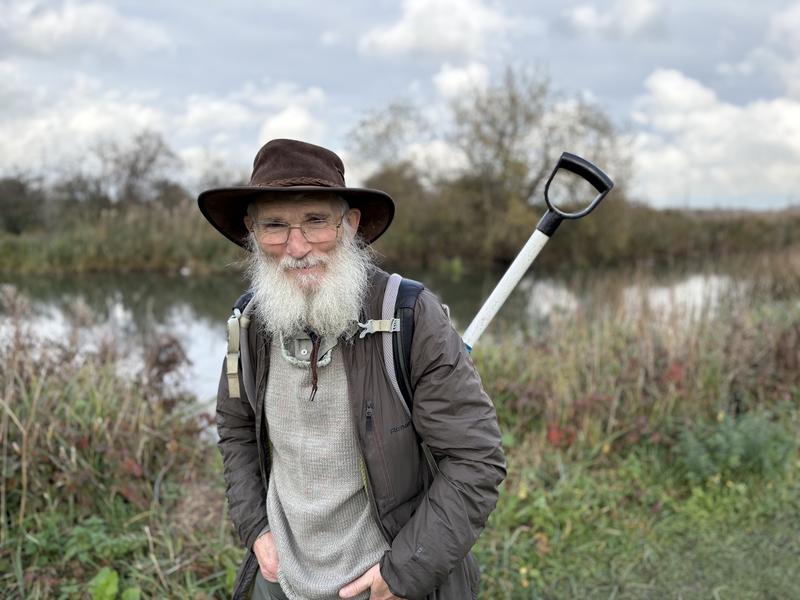
About a decade ago, Dr Keith Kirby featured in an early ‘Living Laboratory’ short film about the University of Oxford’s Wytham Woods. The snow was thick on the ground yet he spoke eloquently about their ecology. He came across (literally and in every other sense) like the incarnation of a grey beard: wise and learned.
Last year he was awarded an MBE, confirming this impression, so QUAD set off to meet him to find out a bit more about the self-styled ‘Old Man of Wytham,’ also the name of a blog he writes.
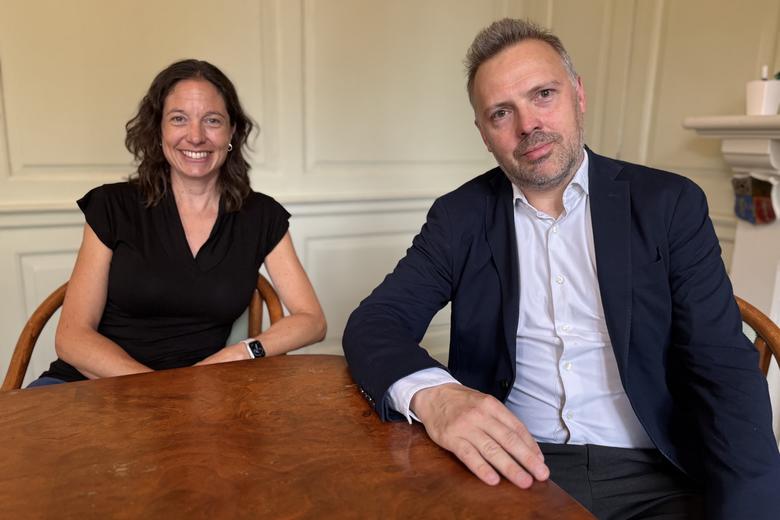
Seated in an archetypal North Oxford front room, blessedly shorn of distractions and phones, we initially cover the MBE experience and what actually happens when you are appointed a Member of the Order of the British Empire (MBE) for services to ecology, forestry and woodland management.
Currently a Visiting Researcher at Oxford’s Department of Biology, Keith says it began with the arrival last May of an impressively thick paper letter announcing the appointment, asking whether he would accept it and whether he would agree to his name being published.
‘You then get invited to one of a series of events where the honour is bestowed, so we went to Windsor Castle in October. The dress code is morning suit, smart lounge suit, national costume or uniform. I might have gone in my Morris dancing garb but decided against.
‘It was a fun and sunny day. Princess Anne did the deed.’
He says that he met the King, then Prince of Wales, ‘about 30 years ago at Balmoral, walking around in a group, studying the impressive pinewoods there.’
He turns 74 at the end of January, with, evidently, plenty more to do yet, but forest futures require forest pasts these days, the longer the datasets the better. Thereupon hangs a tale about brambles that snags its way through our entire conversation.
His career began at Oxford in the form of a BA 1st Class (Hons), Agricultural and Forest Sciences, Keith having matriculated to Brasenose College in 1970.
That particular degree was subsequently scrapped by the University during the 1980s, prompting a murmur of regret on Keith's part, although he acknowledges that food production is back on the agenda but encoded within other programmes in the University, such as the MSc in Biodiversity, Conservation and Nature Recovery, within the School of Geography and the Environment.
Keith says he knew from the age of 12 that he wanted to work in the woods so while at Brasenose he signed up to Oxford’s MSc in Forest Management (another degree later discontinued), only to realise during a Long Vacation trip to northern Colombia that he was really a biologist interested in forestry rather than a forester in the then prevailing sense of wanting to maximise the yield of sitka spruce. Viewed through hindsight, he says the early 1970s was a low point in the British forest industry when little heed was given to biodiversity or the wider environment.
‘This led to a rather urgent talk with Oxford, upon my return, and miraculously I was placed instead into a DPhil programme in ecology.’
It was that decision that led him into Wytham Woods, and three years later in 1976 to emerge with a dissertation titled, The growth, production and nutrition of Rubus fruticosus in woodland.
Rubus fruticocus is, to you and me, bramble.
Keith laughs. ‘We rather cooked it up. There was an international flavour at the time towards measuring the productive capacity of vegetation. Wytham was covered one third in brambles so I went off to measure them.’
He then left Oxford and his subsequent career was as a civil servant, always connected with forestry. He summarises it on his CV, ‘Forestry and Woodland Officer with the conservation agencies: Nature Conservancy Council (1979–91); English Nature (1991–2006); Natural England (2006–12)’.
He’s been a member or a trustee of numerous bodies connected to woodlands in England and Wales and led the (UK) inter-agency woodland group for the Joint Nature Conservation Committee. He’s at pains to note that he’s not an academic.
Yet he never fully left Wytham Woods and took over monitoring his supervisor’s research plots at five-to-ten yearly intervals. After retirement in 2012 he continued this as a Visiting Researcher in the Department of Plant Sciences (now Biology), so now boasts a 50-year dataset for the brambles. Not bad for a non-academic.
This leads us to a book just published by Oxford University Press, called Wytham Woods, How a Landscape Works – authored by a huge cast of contributors with Keith as the overall editor.
He had helped with another book on Wytham in 2010, leaving one to wonder whether there could really be need of another volume. But it turns out that almost everything has changed in the succeeding years, not least a desire to understand the function of the woods within a broader agricultural estate, and within a rapidly emerging culture of new technology and climate change.
There is a University strategy towards achieving net zero and thus a requirement to accurately determine what the woods might offer by way of offset for all the environmental impact of running a world-leading university. A galaxy of new technologies including drone surveys and terrestrial scanning using LIDAR, leads the book's authors to suggest that Wytham Woods currently offset c.8% of the University’s emissions, ‘…a modest contribution to delivering the University’s ambition of becoming net zero carbon.’
However, Keith reminds us that reducing fossil fuel use remains the more fundamental objective, because the woodlands may yet turn from ‘sink’ to ‘source’. If climate change or disease were to make the woods less productive, they could very well fall below ‘break-even’ in the overall equation between carbon dioxide exhaled and carbon dioxide inhaled.
Nonetheless, the book states, ‘…nature-based solutions such as tree and woodland management can contribute to mitigating climate change and net zero targets…’
The rest of the book is crammed with fascinating data and themes, personalities and case studies. One theme is just how dynamic a wood is, contrary to appearances. Even the past few years have seen ash dieback materially alter the appearance of Wytham.
Keith reminds us that it is wrong to assume that the landscape was pristine and untouched by humans at any stage in the last 10,000 years. ‘Large mammals like the wild ox, bears and lynx were progressively eliminated by about a thousand years ago; wolf and wild boar soon followed. Any species that required massive tracts of forest would have gone extinct at least a thousand years ago. Most of the wildlife celebrated in the Victorian period had already adapted to the woods being managed, mainly as coppice dotted with mature trees, known as “standards”.’
During both World Wars Wytham was heavily cut down to provide timber, whether for trenches or coalmine pit props. The regrowth after 1945 was severely affected in the short term by a rampant rabbit population subsequently decimated by the illegal introduction of the myxomatosis virus in the 1950s.
At the time Dr Kirby did his DPhil, bramble cover was about a third of the woodland flora.
However during the 1970s the strong regrowth of ash and sycamore made it harder for the brambles as light dwindled and the canopy ‘closed’. The other thing that happened was an explosion in deer numbers, leading the brambles to be grazed heavily. That had a knock-on impact on bird and small mammal populations, which have been the focus of other famous long-term studies at Wytham. Today he estimates bramble is about 15-20%, ‘about right, except really there is no right or wrong level just variation over time.’
When awarded his MBE, Keith was described as having ‘a particular interest in wood-pasture systems and their significance for understanding both historical landscapes and contemporary rewilding approaches.’
Behind that lies a story that connects the brambles to a broader insight.
He recounts being stuck on a train between Leeds and Glasgow, to deliver a lecture, in c.2000. By the time he arrived his view of forestry had changed and he had to edit the lecture. The cause was the book by Dutchman Franciscus Vera, Grazing Ecology and Forest History (2000), that argued strongly that wood pasture, defined as fairly open woodland ecologies with grazing animals, were the past natural state rather than ‘closed canopy forests’. Dr Kirby does not agree entirely with this view, but it has formed the basis for a lot of the current buzz around rewilding, and in particular what has been happening at the Knepp Estate in Sussex. This has involved the de-intensification of a formerly arable farm resulting in something much closer to wood pasture but still producing food. Dr Kirby was involved along the way and considers it a success in terms of biodiversity gains.
‘Think of a triad model,’ he says. ‘One, as hands-off as possible, i.e. rewilding; two, areas as productive as possible within regulations, i.e. intensive food farming; and then in between those two extremes on the spectrum, we have three: a wide range of balancing acts, of varied productivity, varied biodiversity and varied wildlife habitats.’
He asks, ‘What's the best mix of ecosystem service and food for a given site, a given landscape?
‘This is not just about Wytham, Oxfordshire, England, Britain; it's about the rest of the world as well. What is the environmental footprint of those items that we are exporting and importing, and what does this imply for the overall carbon budget, the overall biodiversity budget, the overall energy intensity, as well as the balance of payments.’
He laughs. ‘I like oranges, but I don't see Britain producing them soon. So we have to import them, but we can consider which oranges we import: where are they grown, what is the impact of their cultivation on the locality and society?’
Sounding a positive note, he says that the state of Wytham Woods is now better than the smashed mess it was in 1945. There have been losses such as the nightingales, but formerly persecuted birds such as ravens, buzzards and red kites have come back. He believes he saw a polecat near Stanton Harcourt in around 2018, ‘running down the road.’
Brambles are now seen as a fast-cycling source of nutrients, a ‘keystone species of the woodland understorey’, the productivity per square metre up to 400g of carbon per annum, compared to perhaps 100g if left as grass.
He has gone from mild scepticism about climate change in the early 1990s to thinking that it will have a much more radical impact than people assume. He notes that sunflowers and olives are already being treated as commercial crops in the UK, unthinkable when he was a boy, while ‘vineyards are the fastest category of land use change.’
He has just completed an initial draft of a book about oak trees due for publication next year, and comments that the English oak may give way in places to other species better suited to frequent droughts and hot weather.
We remember to ask for a piece of career advice and a piece of wisdom. On the former, Kirby says, ‘My DPhil opened a way into the conservation work that I did and enjoyed for 35 years. However, my thesis was full of errors that would have been spotted had I worked more with others; and at various times since in my career things have gone wrong when I have relied too much on my own judgement. Collaboration is key!’
As for summary wisdom, he says: ‘...often the science is easy, it's the people and politics that's difficult. The owner will say yes, but. “Yes, but I've got a pheasant shoot. Yes, but I have no deer control. I want to produce timber or I don't want to produce timber.” These practicalities will take you in different directions, even if the scientific solution is obvious. That said, a diversity of landowners is required. It’s not the case that big or small landowners are good or bad. There are good and bad of all types. This has always been the case throughout history. We don't want to restrict the liberties of citizens and wood owners, unnecessarily: too many regulations would stop things happening that are needed to improve our woods for wildlife. What we're left with is a balancing act, but with, hopefully, more knowledge leading to more often the right kind of action.’



 Pause slideshow
move to carousel content
Pause slideshow
move to carousel content