



HOLLY ELLIS
FROM LITTLE ACORNS…
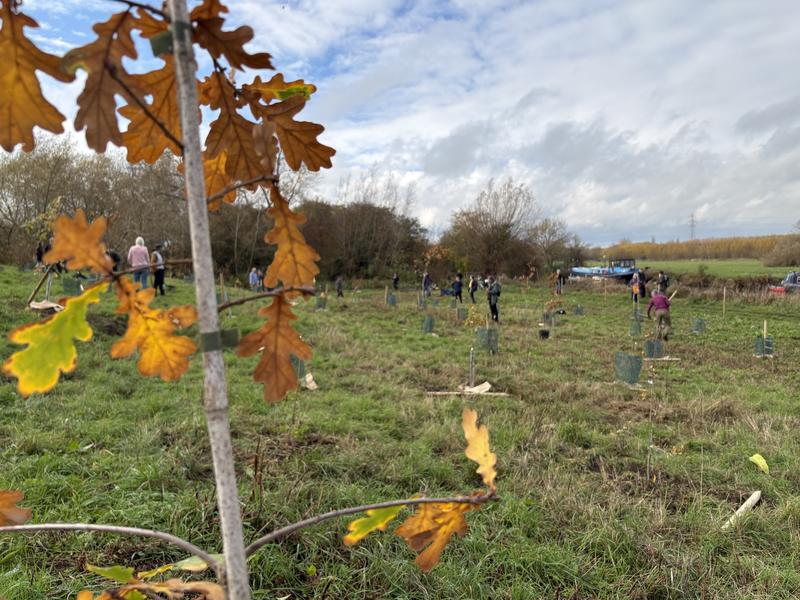
Friday 7 November witnessed the planting by volunteers, in just one day, of a new infant oak pasture woodland by the River Thames, an extension of Wytham Wood on its western boundary.
The culmination of three years of meticulous preparation, the day unfolded fast and productively with a huge turn-out of volunteers carrying oak saplings and shovels along the footpath that begins at Swinford Lock.
After a few hundred metres you come to a lovely compartment of grass on the right, sloping up to a field boundary already lined with hedge and trees, some of them mature. Fenced unobtrusively for protection from deer who are known to be partial to an oak leaf, the whole site is publicly accessible via the footpath by the river, with a couple of house boats there to bring a romantic splash of colour to the scene.
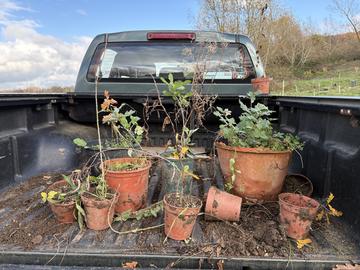
Upon arrival volunteers chose a plot marked out by bamboo sticks and dug holes to plant their oaks in.
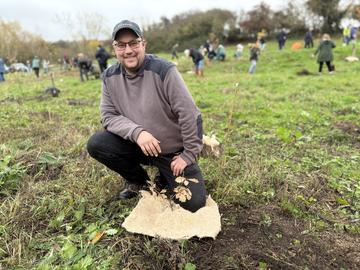
Lee Price, one of the Wytham foresters (pictured, above right), explained that the Wytham team will take on the management of the oaks, allowing everyone to breathe an almighty sigh of relief. That’s because in 2025, planting any tree has become a perilous business because of drought and other challenges that can lead to widespread failure without careful management.
In this instance, natural wool mulch mats were supplied, greenwood stakes, rabbit guards and fine mesh enclosures. Superb.
Only time will tell whether the trees at the base, closer to the river, will outgrow their higher counterparts as the field slopes up, where possibly there will be less moisture.
Over a hundred volunteers attended, many of them with friends or family and typically with an oak sapling. Most were from acorns they had sown in 2022. By the time they left there were approximately 150 trees in the ground.
QUAD previously featured the Oxford alumnus who collected many of these acorns, during the very phase when he was collecting them, Benedict Pollard (St Hugh's, 1992).
We caught up with him again. He says that his aim is the 'raise the vibe', as he puts it, gathering acorns from 'resilient ancient native oaks'.
'These "mother" oaks are usually over 400 years old, several being over 1,000 years old, having lived through both the "Medieval Warm Period" and the "Little Ice Age".' His nursery now has over 2,500 such oaklings, which are up to ten years old. 'I take great delight in meeting and supplying trees to a myriad variety of oak-appreciators!'
He estimates that parent oaks for the Wytham acorns were around 450 to 500 years old, just coming into their prime maturity.
The original hope had been to plant the oaks in November 2024, but it was such a dry year that the decision was made to postpone for one year.
The idea of sponsoring a tree, indeed naming it – naming tags were provided for volunteers who wanted them – evidently carried powerful meaning.
We spoke to several individuals who were honouring loved ones who had passed away, and the symbolic act of planting the saplings obviously carried weight, quite apart from the landscape enhancement and other nature- and climate-enhancing elements.
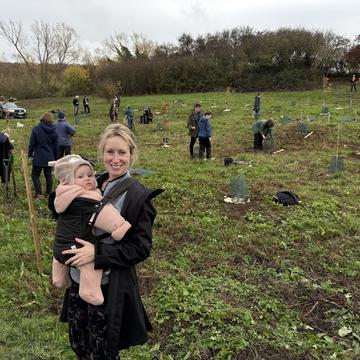
Rebecca Frances Thomas (pictured, left), a teacher at Magdalen College School, was there with her husband and infant daughter, and says that they would like to watch the tree grow alongside their daughter.
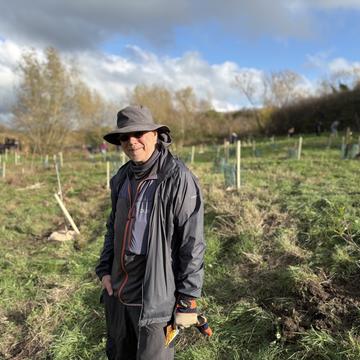
Taylor Bennett (Wolfson, 2017) (pictured, below right), a current mature student in the Archaeological Science DPhil programme, spoke of three friends who had passed away recently, one of them a relatively young academic who had succumbed to COVID, leaving behind a young family.
Another refrain we encountered was the degree to which Wytham Wood is regarded by local residents. They may otherwise have no particular reason to interact with the University, but they have their walking permits for the 400 acres of woodland, surely the greatest natural jewel in Oxford’s estate and a rare instance of a large, uninterrupted woodland in an otherwise denuded county.
Wytham Conservator Nigel Fisher, who is responsible for the 1,000 acre estate, explains that the woodland is named after the surrounding field, denoted ‘Bear Hill’ on the oldest map they can find. ‘It’s a formerly grazed field that simply looked like a suitable way to expand Wytham Woods. As we knew Ben [Benedict Pollard] and his project Mighty Fine Oaks, the growing on of acorns by local communities and permit holders seemed a positive way forward.’
Describing the site might sound confusing because no one thinks of Wytham Wood by the River Thames. Surely it is up on the hill you climb from the village of Wytham?
Study the map, however, and the wood extends west and falls back down that hill until it hits the Thames on its lazy, eastward progress towards Oxford, long before it carries on towards London.
Here, it is still a smaller river, big enough for many craft and various moorings but essentially a more innocent, rural expression of a water course, unthinkably distant from the industrial tideway in London.
If you are trying to find it, enter the Swinford Toll Bridge on Google maps, the one where, slightly absurdly, passing cars still have to pay 5p to proceed, cash only.
The footpath begins immediately south of the bridge, proceeding east. The wood is named so you should see it immediately to the right of the footpath.
From little acorns 150 saplings have grown, and hopefully – and with careful stewardship and no doubt some judicious thinning – mighty oak trees will grow, perhaps to feature in a valuable Wytham research project, but also to enhance public enjoyment of this lovely bit of the land.
move to carousel movement controls
 Pause slideshow
move to carousel content
Pause slideshow
move to carousel content

OXFORD'S NEW DEGREE
OXFORD'S NEW DEGREE
SARAH RUDEBECK
SARAH RUDEBECK

OFF THE SHELF: SEPTEMBER 2026
OFF THE SHELF: SEPTEMBER 2026

ELLA BARON
ELLA BARON

THE IMPORTANCE OF VACCINE ADVOCACY
THE IMPORTANCE OF VACCINE ADVOCACY

SILICON VALLEY CAREER TALK
SILICON VALLEY CAREER TALK

DEGREES WORTH IT AFTER ALL
DEGREES WORTH IT AFTER ALL

OFF THE SHELF: AUGUST 2026
OFF THE SHELF: AUGUST 2026
THE RISE OF BACTERIAL RESISTANCE FROM POULTRY FARMS
THE RISE OF BACTERIAL RESISTANCE FROM POULTRY FARMS

NATURAL HISTORY AT OXFORD REVAMPED
NATURAL HISTORY AT OXFORD REVAMPED

OFF THE SHELF: JULY 2026
OFF THE SHELF: JULY 2026
Pause slideshow

