
REMEMBER NOW?
ELLA BARON
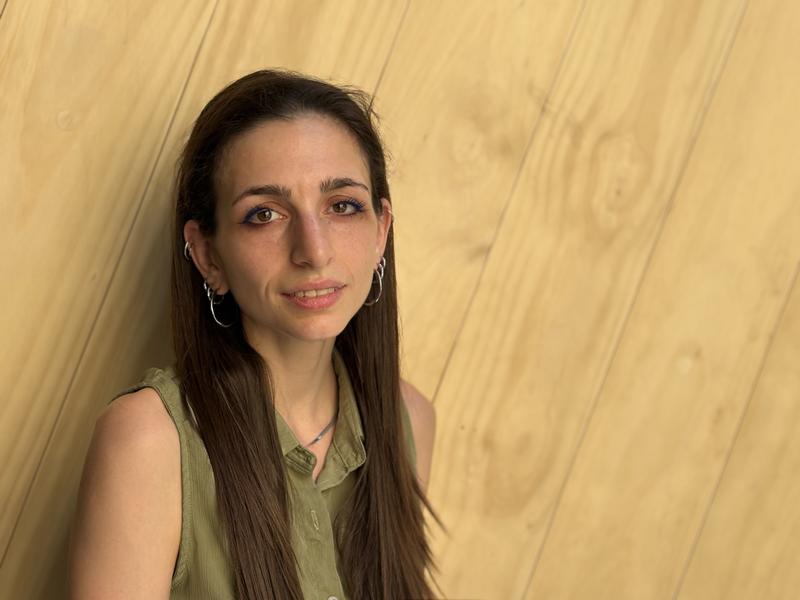
Ella Baron (Merton, 2014) meets me near The Guardian newspaper office, just above King's Cross, London. She took part in May in a panel discussion in Oxford concerning the function and purpose of satire, held at the Sheldonian Theatre. There were so many fascinating issues that bubbled up that it seemed like a great opportunity to continue the discussion.
We start by talking about Interface, a graphic novel which has been six years in the making. ‘It’s probably the project I care most about,’ she says. ‘It's a mixture of social satire, sci fi and romance set many centuries in the future. Maybe a bit Brave New World with a focus on tech, the environment and social inequality. Many of the topical ideas I draw on for the newspapers have informed Interface…but hopefully treated with a bit more nuance than I have time for during a cartoon deadline.’
Is it hopeful? ‘The book is set in a dystopian society, but I guess you could say the characters try to build their own personal utopia within it. It's a perspective in the future that allows us to talk about the present.’ This is a theme that returns, the ability of a picture to create a distorting mirror that is both present and future, a sort of looking down, looking back but to now.
Crucially, she notes, with the novel she's ‘not accountable to the truth’, which is an early clue about the daily requirement of being a cartoonist on a major national newspaper, where a fast decision has to be made on how to portray a snapshot of a news event, depicted from a particular funny and/or sardonic/satirical perspective, to elucidate a particular truth either about a person or an event.
Interface will be published by Virago in 2028, and work on it began right back in lockdown, when Ella worked as a cartoonist for The Times Literary Supplement.
‘I really like the long, slow burn, with no immediate deadline, which, of course, is balanced by the bi-weekly cartoons I do a week for The Guardian, where you've really got a really short timeline, 4-6 hour turnarounds depending on the news cycle that day.’
During the Sheldonian panel discussion, Ella’s work was projected up onto a big screen behind the panellists, something she says she insisted on.
‘You have to see cartoons to understand them.’
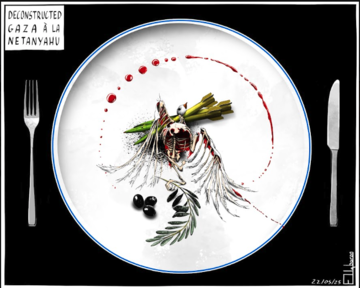
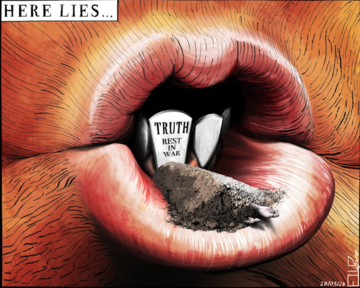
There were some very razor-sharp depictions, such as ‘Deconstructed Gaza à la Netanyahu’ – a plate of food with a skeletonised dove, the rim of the plate offering droplets of jus resembling blood (above, right). In another cartoon, she depicts Trump as a great orange blobby maw with a graveyard floating in his mouth, and the caption ‘Here Lies Truth… Rest In War’ (above, left).
Routinely she says she is ‘unfollowed’, a sort of micro-cancellation, by readers who feel she has attacked their cause. The next day, however, it might be the opposite group who dislike her cartoon.
‘If that’s the case I’m doing my job correctly. Newspaper cartoonists are journalists, not activists. Obviously, I have my own personal opinions and politics which inform the angle of a cartoon – but you also have to treat each day’s news as it comes rather than looking for a particular cause to fight.
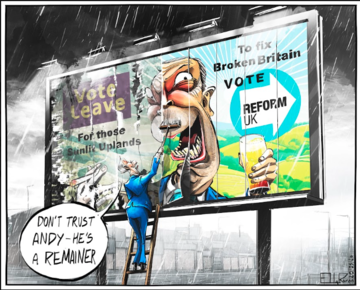
Ella explains that this happened recently with a cartoon which contrasts Farage’s unfulfilled promises during the Brexit campaign with the promises he’s currently making for Britain under Reform (right).
‘That cartoon got a lot of traction online – people thought the brush placement on Farage’s face on the poster was meant to be a moustache, thinking I had deliberately made an oblique likeness between Farage and Hitler! But I didn’t intend that at all…’
‘The meaning of a cartoon is implicit not explicit. What is brilliant about that is that we get away with more than you could probably write. But also if you didn't intend something to be offensive, but everyone thinks it is, that’s still on you.’
She says it’s too easy to forget how quickly a cartoonist has to work, ‘how easily we can get it wrong’. Balancing it are conventions within the broader cartoon landscape. She says there are shared visual conventions, such as focusing on Trump’s tiny hands, or the pinkness around his eyes. ‘Rishi Sunak was always portrayed as being tiny, even though he wasn't actually that tiny.
‘Over time, and it takes a while, you are trying to evolve your own approach. We're better off when we follow our own instincts.’
She says that her developing outlook ‘is not just to cut people down’.
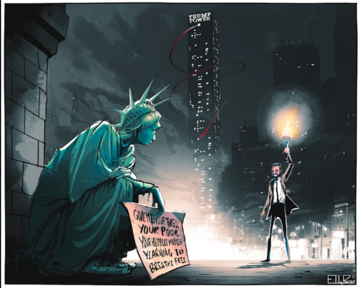
‘I want to evoke empathy and hope as well as anger and sadness. We're in a world right now where the baseline is terrible. So, in a sense there's not much room to twist to something really terrible, because it is already perceived as being terrible. Rather than twisting down you can try and twist up.’ She says she got a lot of warmth for depicting the recent election of New York Mayor Zohran Mamdani (left).
Ella worked a stint for medical aid group Médecins Sans Frontières (MSF). So we turn to that for a moment because it offers a different take on her work as an artist.
For someone so young, Ella has a formidable work track behind her. She spent long spells in South Sudan, Lebanon and last year in Ukraine, all with MSF. In South Sudan, she visited a maternity hospital. ‘Women would sometimes travel two days on foot to give birth in that hospital. There was really a strong aversion to photography. Patients deserved privacy. Drawing is a human, interactive activity. We say, don’t we, that we have ‘captured’ or ‘taken’ a photo, short of ‘stolen’ but the words link. That said, I learned a lot. Some of my work from that period, it didn't work, and I didn't really know what I was doing. But I think each project got a bit better.’
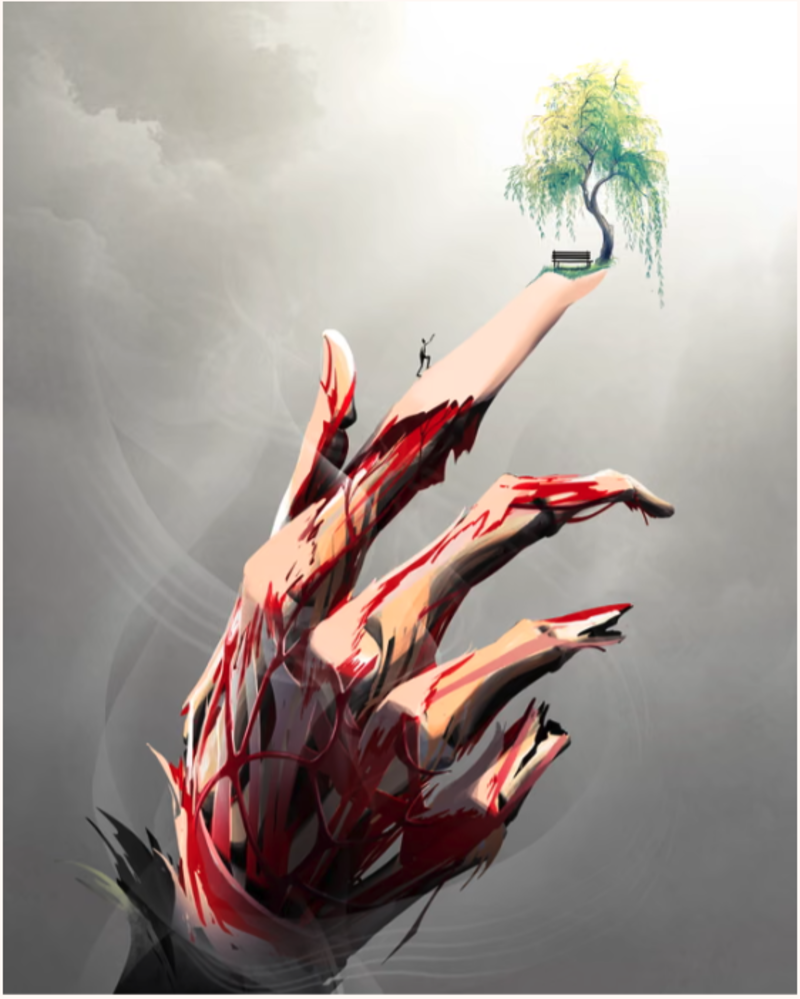
She also went to a rehabilitation centre for war veterans in Cherkasy and a mental health clinic for internally displaced families in Vinnytsia in 2025, both in Ukraine. In the subsequent piece published in The Guardian last July, she wrote:
‘I drew what people told me, as well as what I saw, because trauma and hope are intangible things of memory and imagination. There’s nothing left to draw of an amputated limb but memories – the same could be said for a lost home or relative. These things are beyond a camera’s reach, which I think gives you licence to reach for a pencil.’
She built her field sketches into nine cartoons published by The Guardian and exhibited at Bush House on The Strand, part of King's College London.
The contrast between this work and her daily cartoons is pronounced (see right).
‘Since Russia’s full-scale invasion of Ukraine, I’ve drawn many political cartoons about the war: drawings that tend to feature Zelenskyy, Putin and the occasional bear. It looked very different from the ground, where war is fought and lived by ordinary people, just like us.’
We turn to current affairs. British Prime Minister Sir Keir Starmer had stood in front of the podium and resigned in Downing Street the very day before our meeting.
‘It's quite painful,’ she says, ‘the journey that's been enacted between Starmer coming to power, to him stepping down. I don’t think he had enough of a story, both about who he is and who or what the country is. We’re still none the wiser.
‘Andy Burnham is a new face’.
We talk about the already compelling image taken on Monday 22 June of soon-to-be Prime Minister Burnham strolling into Manchester Piccadilly station with two aides and a police guard. He was wearing a black T-shirt. At some point between Manchester and London he changed into a suit. It was symbolic of him travelling south to Westminster, such an extraordinary moment in his journey, both political and personal. But when did he put that suit on? It's already become a subject of interest. At what point did the Mayor of Manchester become the Prime Minister-in-waiting?
We talk about possible personality traits that might work for a cartoonist and Andy Burnham. Ella mentions his famous bambi eyelashes.
Casting back to Oxford, and Merton, she says that ‘when you’ve grown up in London, Oxford can still seem a bit of a bubble. A fantastic bubble but one I was still ultimately glad to get out of.’
She studied English, not relishing all of the curriculum but enjoying Shakespearian depictions and other visual identities arising from Edmund Spenser’s contemporary The Faerie Queene, ‘crowded with complex symbols and metaphors’, not unlike a political cartoon.
During her second year Ella became cartoonist for Cherwell.
Suddenly we are back at the confluence of cartoons, graphic novels and Renaissance literature.
She says she's drawn from the earliest age. ‘[As a child] I was obsessed with roundabouts, to the point where people were worried about me!’ She laughs. ‘My parents would say, draw a tree, and I’d draw a roundabout. Then they would say, draw mummy, and I’d draw a roundabout. I have dyslexia and apparently this spatial disorientation isn’t uncommon. I love spiral composition and I’ve always been able to think in three dimensions, to see a scene. Cartoons are often situations where you rotate a given scene so that you're looking at the politician or person from the side or from behind.’
In her anticipated graphic novel, she explains how it takes the form of two parallel stories, one on each of the facing pages showing the lives of two protagonists. It weaves together two narratives like Art Spiegelman’s Maus, a celebrated graphic novel from the 1980s about his parents’ experience in the Holocaust.
‘The reader puts the pieces of the narrative together in their own head; things leak across the page, and there are parallel plots shown at the same time. I love this, I love fragmented forms and simultaneous visuals.’
https://www.youtube-nocookie.com/embed/67wf8SYmwag
move to carousel movement controls
 Pause slideshow
move to carousel content
Pause slideshow
move to carousel content
HOLLY ELLIS
HOLLY ELLIS
OXFORD'S NEW DEGREE
OXFORD'S NEW DEGREE
SARAH RUDEBECK
SARAH RUDEBECK
OFF THE SHELF: SEPTEMBER 2026
OFF THE SHELF: SEPTEMBER 2026
THE IMPORTANCE OF VACCINE ADVOCACY
THE IMPORTANCE OF VACCINE ADVOCACY
SILICON VALLEY CAREER TALK
SILICON VALLEY CAREER TALK
DEGREES WORTH IT AFTER ALL
DEGREES WORTH IT AFTER ALL

OFF THE SHELF: AUGUST 2026
OFF THE SHELF: AUGUST 2026
THE RISE OF BACTERIAL RESISTANCE FROM POULTRY FARMS
THE RISE OF BACTERIAL RESISTANCE FROM POULTRY FARMS
NATURAL HISTORY AT OXFORD REVAMPED
NATURAL HISTORY AT OXFORD REVAMPED
OFF THE SHELF: JULY 2026
OFF THE SHELF: JULY 2026
Pause slideshow

